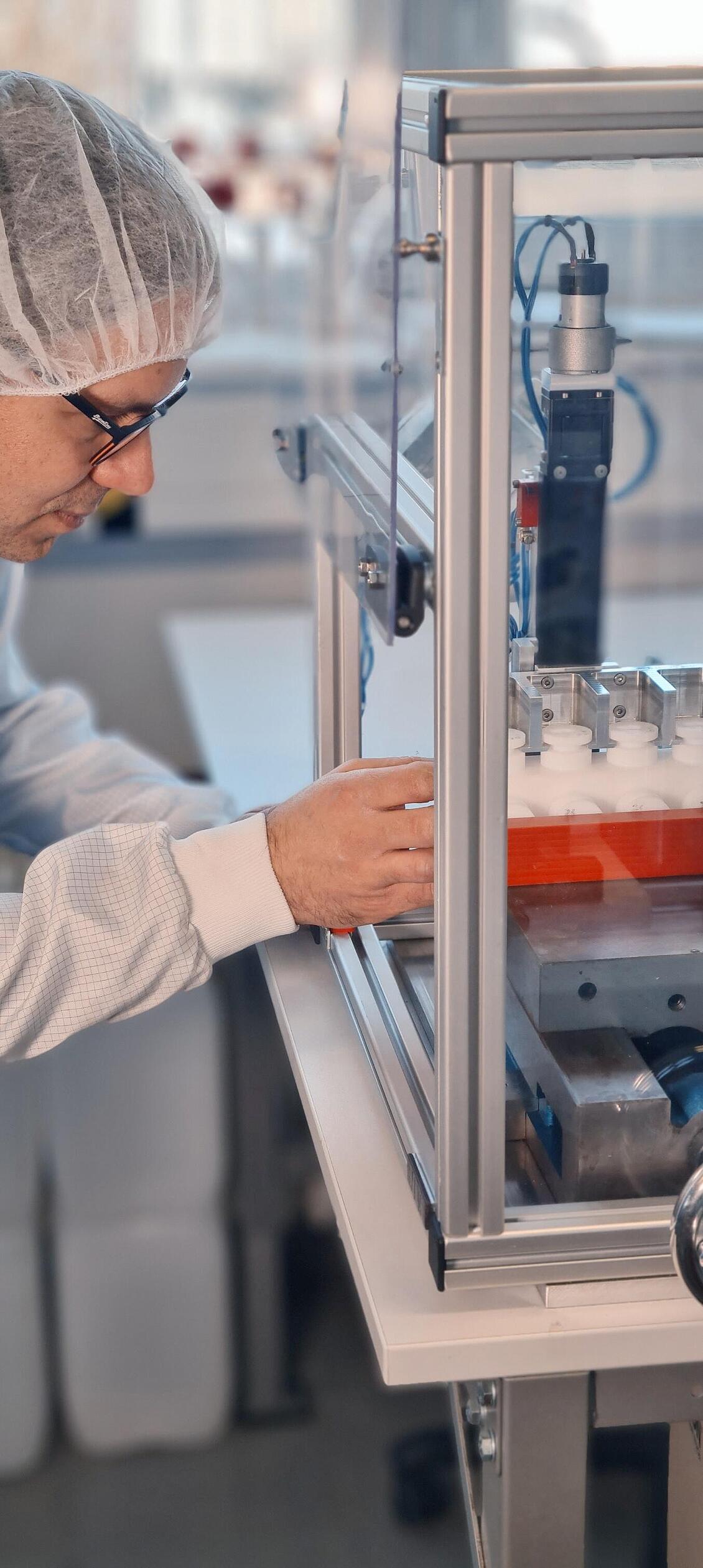
Quartz Cold Casting enables the production of quartz glass components that conventional manufacturing methods cannot produce. This innovative casting process based on a liquid sol allows for precise and flexible component geometries made of quartz glass in a single casting. The result is components with smooth transitions, high mechanical stability, user-friendly handling or functional structures such as integrated sealing surfaces.
The process offers decisive advantages, particularly for complex designs, small volumes, or applications with high requirements for cleanability and sample recovery.
In short: Quartz Cold Casting greatly shortens the path from concept to fully functional quartz glass parts, improving time-to-market. With QCC, OEM customers benefit from exceptional manufacturing expertise that significantly accelerates product development.
Cost-effective to manufacture - especially compared to traditional manufacturing processes
High mechanical stability for durable and robust components
Seamless, smooth transitions for optimal cleanability and hygiene
Easily scalable - from small batches to mass production
Maximum design freedom thanks to high flexibility and adaptability
Seamlessly combinable with established machining and joining processes for quartz glass
Full traceability - from raw material to finished product
Every application has its own unique requirements. That is why we provide expert support from the initial idea to the finished solution—in a structured, efficient, and collaborative manner:
|
|
|
|
|
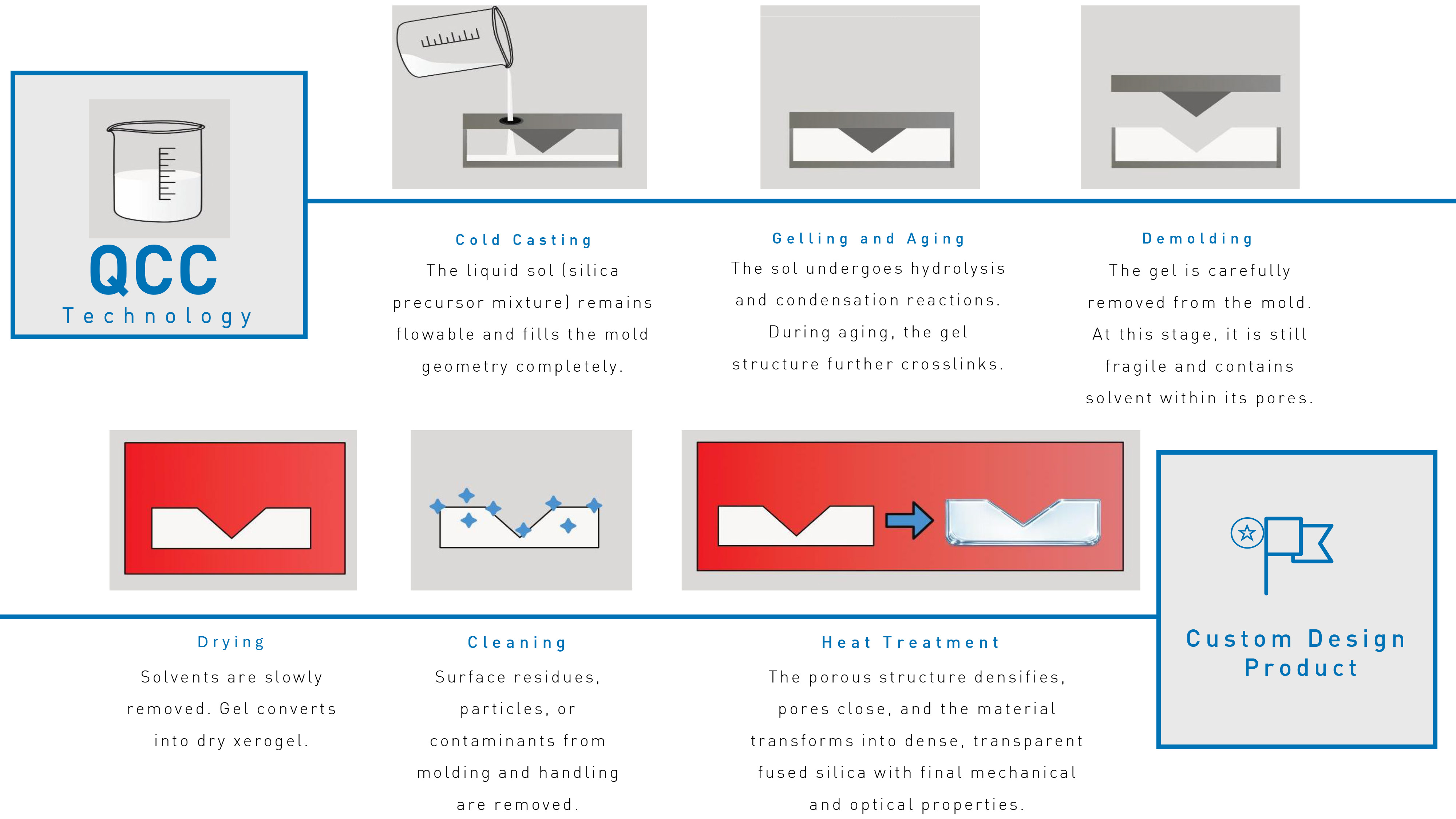
Using the QCC process, a silicon-containing casting material is introduced into molds at room temperature. After curing, the material is converted into high-purity fused silica in a thermal step, meeting the required optical performance specifications.
The resulting product is manufactured as a single, seamless component. This monolithic design replaces multiple production steps typically required for conventional fused silica components, enabling a more efficient, transparent, and well-documented manufacturing process.
This manufacturing approach offers a high degree of design freedom. As the molds can be flexibly adapted, the geometry of the desired components can be precisely tailored for accurate and straightforward integration into the customer’s application. Functional features, such as sealing surfaces between glass and customer components made from materials like polymers, can be directly integrated into the quartz structure.
In the QCC process, highly pure synthetic raw materials are used to produce ultrapure quartz glass, ideally suited for a variety of optical, analytical, and technical applications. The properties of the resulting quartz glass are essentially equivalent to those of standard commercial quartz glasses.
Hellma Material 511 refers to a transparent quartz glass grade characterized by exceptionally high transparency from the UV to the IR spectral range.
Hellma material 518 is a carbon-doped, black-colored fused silica that serves as an absorber in optical applications
Data sheets containing additional material properties are available upon request:
Strong engineering expertise and over 100 years of experience in tailored components
Interdisciplinary teamwork and committed support throughout every development phase
Flexible production capabilities — from prototypes and small batches to large-scale manufacturing
Profound application know-how across numerous industries
For its BioPAT® Spectro UV Single-Use Pipe sensor interface,used for UV spectroscopic determination of biomolecule concentrations,Sartorius was seeking a highly sophisticated single-use flow cell made of quartz glass.
By leveraging Hellma’s QCC manufacturing process combined with agile project management approaches and highly flexible production capabilities, all customer-specific requirements were successfully realized. This included the implementation of an integrated structure to ensure reliable sealing between glass and plastic components.
Through close collaborative development, a cost-efficient flow cell solution was created. The monolithic, high-precision optical design significantly simplifies the manufacturing process and enables the efficient use of UV spectroscopy in this application.
With the successful implementation of this customer project, the new cold casting manufacturing process was effectively established for producing cost-efficient single-use optics for UV spectroscopic analysis in biotechnology.
The flexibility and efficiency in meeting specific customer requirements make QCC technology highly attractive for a wide range of additional applications, particularly in the chemical, pharmaceutical, biotechnology, and food industries.
Innovative glass casting process enables customer-specific precision parts made of quartz glass for applications in optical analytics
Thank you very much for your interest in our download of "Innovative glass casting process enables customer-specific precision parts made of quartz glass for applications in optical analytics". Please fill in the form below and we will send you the requested link to the given e-mail address.
Start your Quartz Cold Casting project with Hellma today. Our experts will be happy to advise you and discuss your specific product requirements with you.